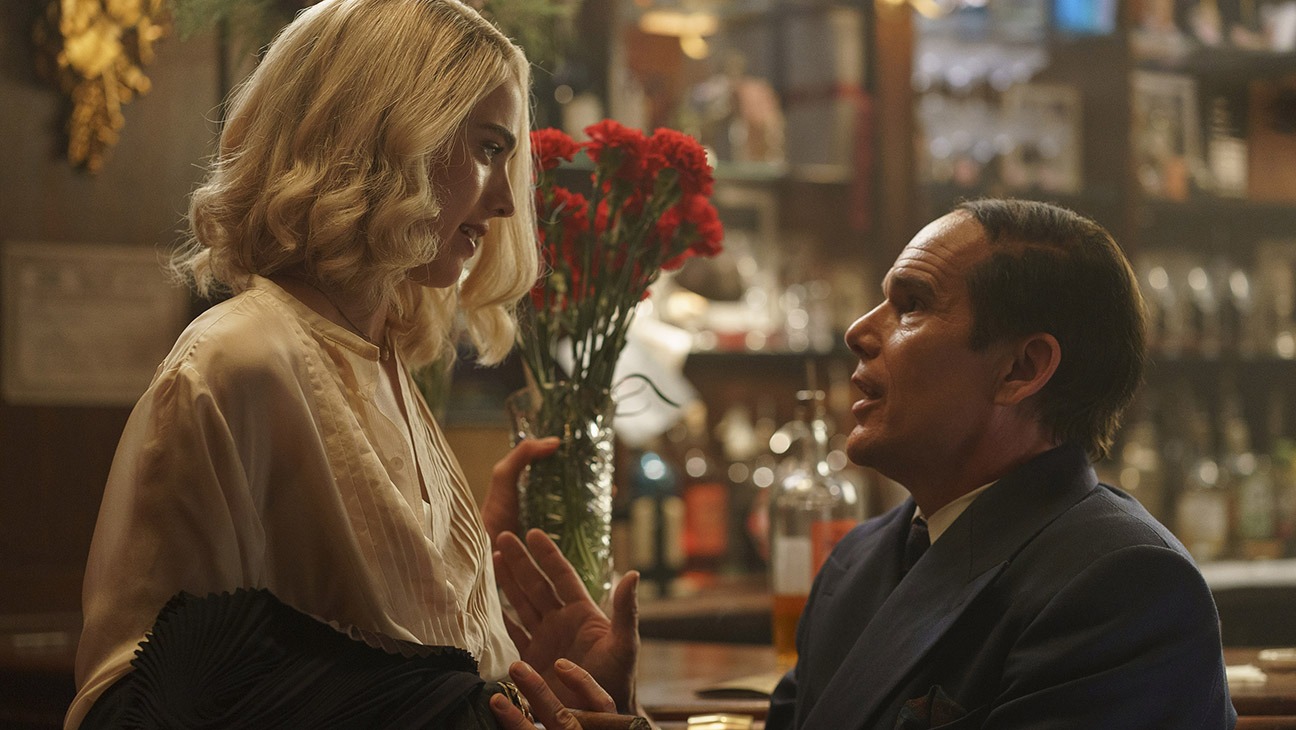
Blue Moon is a story about brilliance, betrayal, and the quiet agony of a creative mind slipping into obscurity. On March 31, 1943, lyricist Lorenz Hart (Ethan Hawke) slips into the after-party for the opening night of Oklahoma!. The new musical is the brainchild of former partner Richard Rodgers (Andrews Scott) and newcomer Oscar Hammerstein II (Simon Delaney). Once part of a celebrated collaborative duo, Hart now finds himself a step behind. His reputation waning, his drinking escalating, and his unrequited longing for both love and professional renewal ever present. As the evening unfolds at the bar, Hart wrestles with his demons. He weighs his professional irrelevance, personal vanity, and the shrinking audience for his wit and lyricism.
What works in Blue Moon is Hawke’s commanding, raw performance. He rises to the excellent work of the supporting cast, the vivid writing that snaps with electricity, and the filmmaking craft. This mix elevates the tightly framed night into something theatrical and alive. Hawke embodies Hart’s frenetic energy. He exudes charm, self-deprecation, creative restlessness and creeping despair. He bounces off a superb ensemble that includes Margaret Qualley, Bobby Cannavale and Andrew Scott. Each brings depth and texture to their roles as Hart’s interlocutors, admirers and rivals. Writer Robert Kaplow (Me and Orson Wells) and director Richard Linklater (Hit Man) fashion a screenplay that hums with quick dialogue and character turns. Additionally, the cinematography and production design steep the film in an evocative 1940s Broadway ambience. Together, they make the evening feel both intimate and electrically charged. It’s as if the spotlight is on Hart even when he’s off stage.
RELATED: Ethan Hawke On What Made Him Join Moon Knight
Audiences who dislike real-time narratives or claustrophobic environments may not enjoy Blue Moon as much as others. The film spends nearly its entire runtime inside one location. The pace, though engaging, hinges on dialogue and character rather than action. Hawke’s character is “on” for much of the film. Audiences are subject to his endless wit, insecurities, and charisma. This means viewers might feel fatigued by the relentless presence of his persona without much relief. For some, Hart’s self-destructive behavior and the lack of conventional plot arcs may feel more grueling than galvanizing.
Blue Moon is a powerful character study. Anchored by a career-best turn from Hawke and elevated by Linklater’s light yet precise touch, it can be mesmerizing. It’s a film about a man being left behind while the world moves on. And in that nervous twilight, it finds a kind of haunting beauty. Strongly recommended.
Recommended if you enjoyed: Birdman, The Favour, and Inside Llewyn Davis
Blue Moon is now available for rent/purchase on most digital platforms.
 FOR FANBOYS, BY FANBOYS
Have you checked out LRM Online’s official podcasts and videos on The Genreverse Podcast Network? Available on YouTube and all your favorite podcast apps, This multimedia empire includes The Daily CoG, Breaking Geek Radio: The Podcast, GeekScholars Movie News, Anime-Versal Review Podcast, and our Star Wars dedicated podcast The Cantina. Check it out by listening on all your favorite podcast apps, or watching on YouTube!
Subscribe on: Apple Podcasts | Spotify | SoundCloud | Stitcher | Google Play
FOR FANBOYS, BY FANBOYS
Have you checked out LRM Online’s official podcasts and videos on The Genreverse Podcast Network? Available on YouTube and all your favorite podcast apps, This multimedia empire includes The Daily CoG, Breaking Geek Radio: The Podcast, GeekScholars Movie News, Anime-Versal Review Podcast, and our Star Wars dedicated podcast The Cantina. Check it out by listening on all your favorite podcast apps, or watching on YouTube!
Subscribe on: Apple Podcasts | Spotify | SoundCloud | Stitcher | Google Play